Best StudioBinder Alternative for Film & TV Pitching in 2026
Jack / July 6, 2026
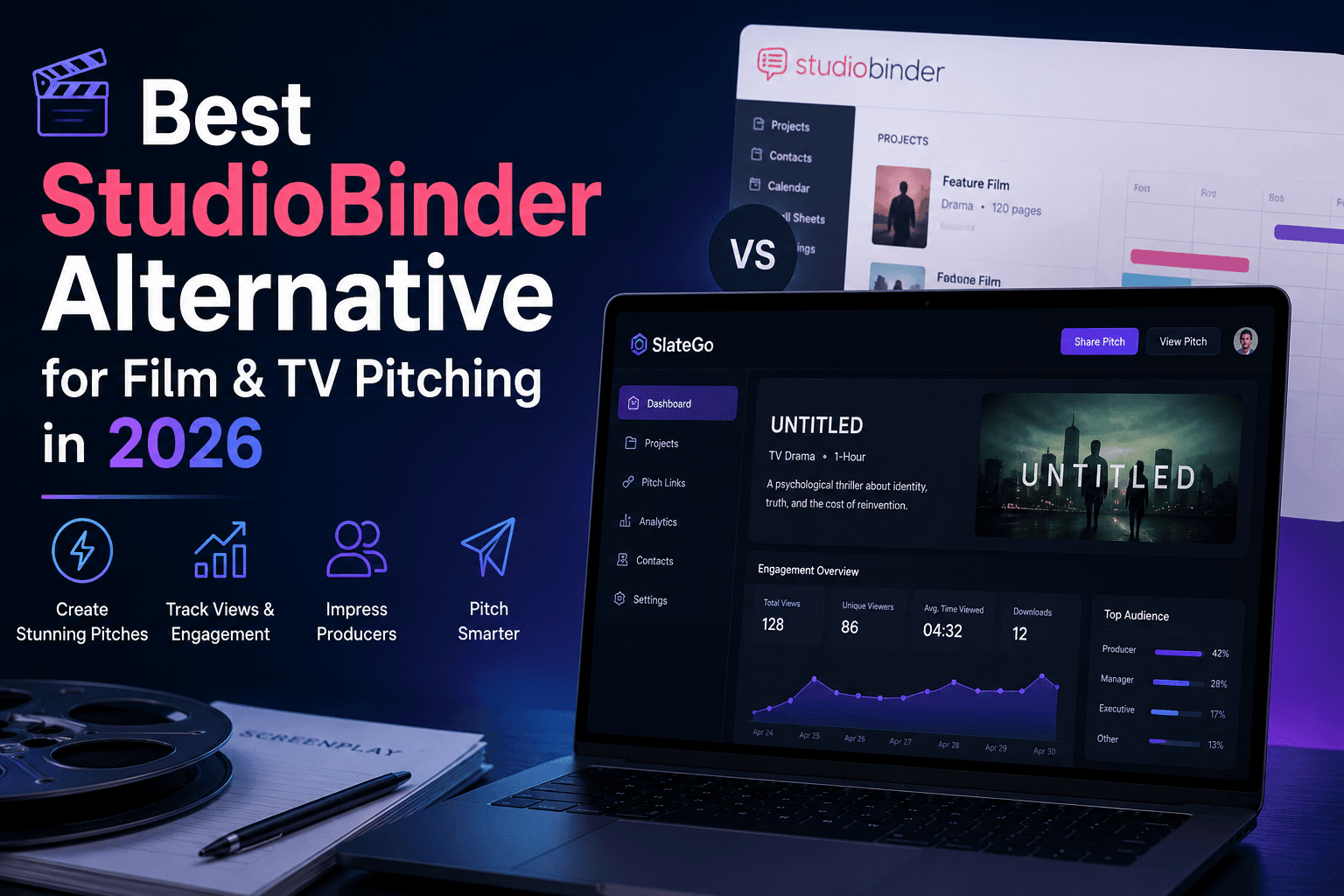
StudioBinder is an excellent tool. It's arguably the best production management platform in the industry — call sheets, shooting schedules, script breakdowns, shot lists, storyboards. If you're in active production, it delivers.
But here's the problem: StudioBinder was built for the production phase. Not the pitching phase.
And if you're a producer with a slate of projects that need to get in front of buyers, you're stuck in a completely different workflow — one StudioBinder was never designed to handle.
This article breaks down where StudioBinder excels, where it falls short for pitching, and why SlateGo was built specifically for the part of the process that comes before production ever begins.
What StudioBinder Does Well
Credit where it's due. StudioBinder has earned its reputation.
It gives production teams a centralized workspace for the logistics of making a show or film. Script breakdowns flow into stripboards. Stripboards feed shooting schedules. Schedules generate call sheets. Contact management ties everything together. It's a well-integrated system that replaces a pile of spreadsheets, PDFs, and email chains once a project is greenlit and moving into pre-production.
For teams managing active shoots — coordinating crew, locking schedules, distributing call sheets — StudioBinder is purpose-built and effective.
The issue isn't what StudioBinder does. It's what it doesn't do.
Where StudioBinder Falls Short for Pitching
The pitch workflow is a fundamentally different job. You're not coordinating a crew. You're not scheduling shoot days. You're trying to get a buyer interested in a project that doesn't exist yet.
That means you need a different set of tools entirely:
You need to package materials, not break down a script. A pitch involves a deck, a sizzle reel, a script or treatment, a lookbook, maybe a Canva link — all assembled into one cohesive presentation that a buyer can open and review. StudioBinder doesn't have a concept of a "pitch package." There's no way to bundle your creative materials into a single shareable link that represents the project you're selling.
You need to track buyer engagement, not crew confirmations. StudioBinder can tell you which crew members confirmed a call sheet. That's useful on set. But it can't tell you whether an HBO development exec opened your pitch, how many times they came back to it, whether they read your script to page 40 or abandoned it on page 3, or whether they forwarded the whole package to a colleague. That's the data you actually need during the pitching phase — and it simply doesn't exist in StudioBinder.
You need version control for evolving pitches, not locked shooting scripts. Projects go through dozens of iterations before they're pitch-ready. Decks get redesigned. Sizzle reels get re-cut. Treatments get rewritten. You need one living link that always points to the current version — so the buyer never opens a stale file and you never have to wonder which version you sent to which company. StudioBinder's version control is built around script revisions during production, not around the evolving materials of a pitch in development.
You need a development slate, not a production calendar. Producers don't manage one project at a time. You might have eight projects at various stages — two that are pitch-ready, three in development, one that got passed on and needs rethinking, and two that are waiting for the right buyer mandate. You need a way to rank, sort, and prioritize that slate. StudioBinder's project structure is organized around the production pipeline, not around the strategic decisions of what to pitch, to whom, and when.
You need a pitch archive, not a production wrap folder. Film and TV is cyclical. Projects that get passed on come back when mandates shift. A limited series that was "too dark" for a network in 2023 might be exactly what a streamer wants in 2026. If your pitch history — every note, every version, every piece of buyer feedback — is scattered across old email threads and dead Google Drive folders, you've lost institutional memory that has real value. StudioBinder doesn't preserve pitch history because it was never designed to.
The Gap Between "Production-Ready" and "Pitch-Ready"
This is the core issue. StudioBinder helps you make a project once it's been bought. SlateGo helps you sell a project before anyone's said yes.
Those are two completely different stages of the lifecycle, and they require two completely different toolsets.
Most producers recognize this intuitively. That's why they end up with a split workflow — StudioBinder (or something like it) for production, and a messy combination of Google Drive, Vimeo, Canva, spreadsheets, and email for pitching. The production side is organized. The pitching side is chaos.
SlateGo was built to fix the pitching side.
What SlateGo Does Differently
SlateGo is a pitch workflow platform built specifically for film and TV producers. Every feature maps to a real problem in the pitch process.
Pitch Packages: Pull your script, deck, sizzle reel, lookbook, Canva link, and notes into one polished, web-based package. Send buyers a single link — not a thread of attachments or a folder of loose files. When someone says "send me the pitch right now," you do it in seconds.
Buyer Analytics: See who opened your package, how many times they returned, whether they shared it internally, and how far into your script they actually read — page by page. Follow up based on real behavior, not guesswork. If a buyer at A24 has opened your package seven times and forwarded it to a colleague, that's a signal. If they opened it once and bounced, that's a different signal. Both are actionable. Neither is visible without tracking.
Development Slate: See your full pipeline at a glance. Rank, sort, and filter every project by status, priority, or readiness. Know instantly what's pitch-ready, what needs work, and what's been sitting dormant too long. Manage a large slate without it managing you.
Version Control: Set one version as the live outgoing pitch. Update your deck, swap in a new sizzle cut, revise the treatment — the link stays the same. No confusion about which version went to which buyer. No embarrassing moments when a network exec opens a stale file.
Pitch Archive: Every pitch, every version, every note, every piece of buyer feedback — stored and searchable. When an old project becomes relevant again, you have everything. Your development history becomes a reusable asset instead of a buried folder.
Notes & Feedback: Capture buyer notes, feedback, and follow-up context directly inside each project. Not in email threads. Not in Slack conversations. Not in a spreadsheet you'll forget to update. Tied to the project where it belongs.
Do You Need Both?
Possibly. StudioBinder and SlateGo aren't competing for the same job.
If you're a producer who develops and pitches projects, SlateGo handles that workflow. If a project gets picked up and moves into production, StudioBinder (or a similar production management tool) handles that workflow. They sit on opposite sides of the greenlight.
The mistake is trying to force a production tool to handle pitching. It's like using Final Draft to manage your slate — it's a great tool for a different job.
Who SlateGo Is Built For
SlateGo is built for producers, development teams, and production companies who are actively pitching film and TV projects to buyers — broadcasters, streamers, networks, studios, and distributors.
If any of this sounds familiar, SlateGo was designed for your workflow:
- You're managing multiple projects at different stages of development
- You're assembling pitch materials from multiple sources (Drive, Vimeo, Canva, local files)
- You're sending pitches to buyers and following up with no data on whether they engaged
- You're losing track of which version you sent to which company
- You're unable to find old pitch materials when a project becomes relevant again
- You're spending more time organizing files than actually pitching
Try SlateGo Free
SlateGo offers a 7-day free trial with full access to the core pitch workflow — organize, package, share, and track. You can set up your first pitch package in minutes.
If StudioBinder is already handling your production workflow, SlateGo is the missing piece for everything that comes before it.